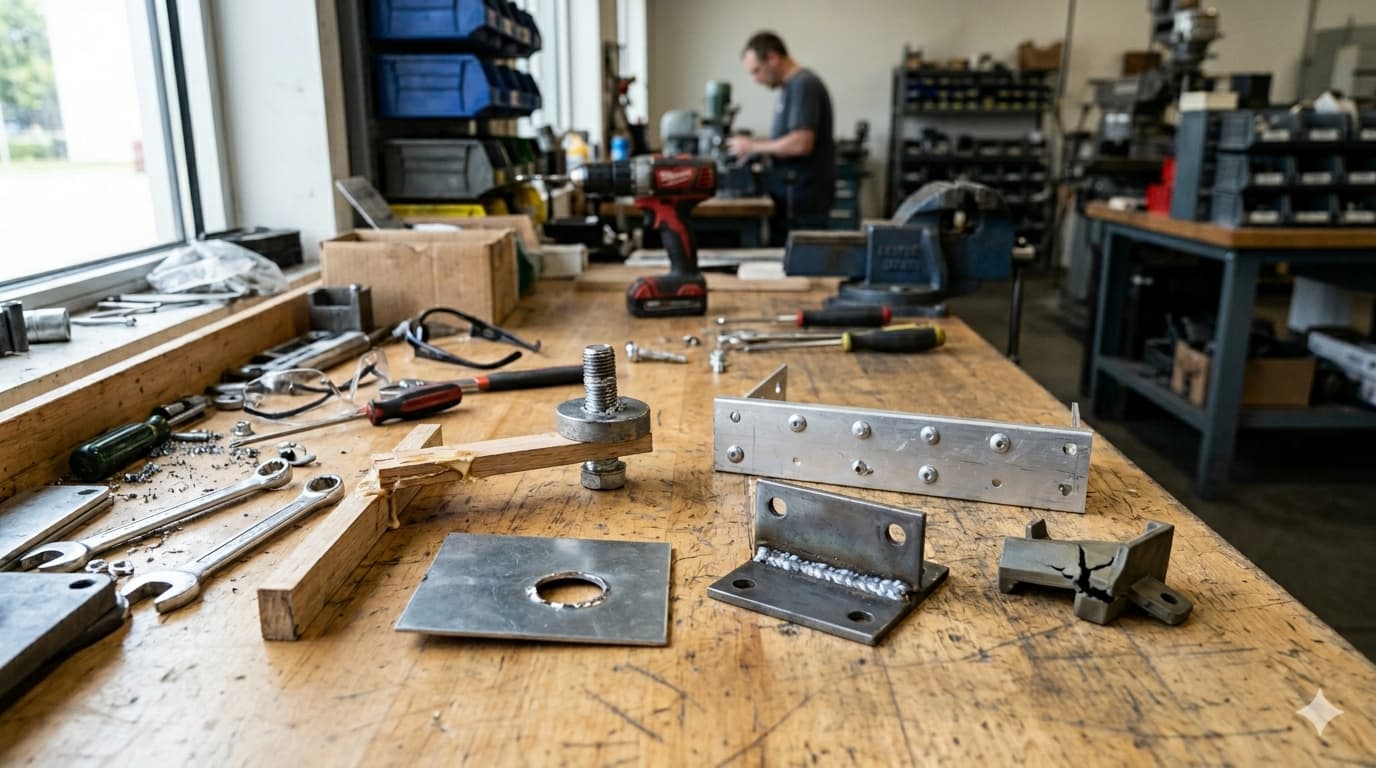
Most assembly failures are not spectacular. There is no single sudden catastrophic event, just a joint that over time loses its integrity until it eventually gives way. The physics of this process are quite well understood. It is the preparatory steps that are required to stop it that are all too often omitted, simply because the materials look as though they are ready when they are not.
The surface preparation problem nobody talks about
A surface may appear to be clean but could be contaminated to an extent that will not allow proper bonding. Residual mold release agents, machining oils, or even fingerprints form a molecular barrier between the bonding agent and the substrate. Failing to degrease a surface can cause more problems than expected based on project deadlines. The choice of solvent is dependent on the substrate. What works to get contamination off of aluminum without leaving residue might not work for polycarbonate or fiber-reinforced composites.
The science behind it is surface energy. Low-energy surfaces (many plastics fall into this category) are resistant to wetting, meaning a bonding agent will not spread out and contact the substrate on a molecular basis. Flame treatment or plasma treatment raises the surface energy before bonding occurs. We see a pattern of neglecting this step with low-energy materials and then discovering that the bond doesn’t hold under load.
Thermal mismatch and what it does to joints over time
When you join two materials with mismatched thermal expansion, all the built-up stress has to go somewhere. If the glue or epoxy is stronger than the materials themselves, something will give. And that something is usually the bond line.
Why mechanical fasteners create problems they’re supposed to solve
When you bolt two pieces together, you’re asking the fasteners themselves, and the host material they are inserted through, to take the loads. When you bond two pieces together, it’s the bondline that does the work. The materials themselves are free to do what they were meant to do, without you poking a lot of holes in them.
Plus, the changes in thermal expansion of the bonded materials are all parallel to the bonding faces, so they don’t try to pry the joint apart – they merely amplify the stress a little. With bolted joints, differential expansion (and contraction) can literally tear the joint apart. Industrial Adhesives distribute load across the full bonded surface rather than concentrating it at discrete points, making chemical bonding the better engineering decision for thin-gauge materials or components where drilling would compromise structural integrity.
Curing conditions that produce brittle joints
A bonding agent that has not been cured properly is likely to fail when put under service loads, even though it may appear fine during a visual inspection. The curing process is a chemical one, and as with all chemical reactions, it can be affected by temperature and humidity. For example, if you cure a two-part epoxy under too cold conditions, the cross-linking reaction becomes slower or even stops, resulting in an undercured and therefore a very brittle joint. If you cure a moisture-sensitive adhesive under high humidity, the chemistry is compromised during curing.
The curing time is the minimum required time for optimal bonding. If you handle a bonded assembly before the adhesive has reached its minimum handling strength, and then fully load it before it is fully cured, that’s a good way to guarantee that your joints will fail in the field. The solution is to follow a specified curing process: Determine the right temperature range, the humidity limits, the minimum handling time, and the full cure time before applying a load.
Matching the bonding agent to the substrate
The ability to fill a joint depends on factors like viscosity and porosity, but substrate compatibility should come first. Some adhesives and sealants work on wood or concrete and not on metal. Others readily bond thermoplastics but attack thermosets by swelling them. Thermoset systems polymerize to gel and cure then cannot react further. Potting an assembly with a thermoset leads to gelled residues inside the assembly and a part that fails from outgassing.
Most assembly failures are preventable. They happen when material selection, surface preparation, and curing conditions are treated as secondary concerns rather than the engineering decisions they actually are.