Florida processed 5,195 cold-stunned iguanas in two days in early February 2025. The construction industry hasn’t grasped the full implications—buildings are being designed for the wrong threats.
When a late-winter cold snap hit Florida in early 2025, thousands of green iguanas fell from trees. The Florida Fish and Wildlife Conservation Commission opened temporary drop-off sites on February 1-2. Residents collected the stunned reptiles by the thousands. Some went to licensed handlers. Others were euthanized. A few ended up as exotic leather goods or restaurant specials.
The Real Cost of Ignoring Biology in Building Design
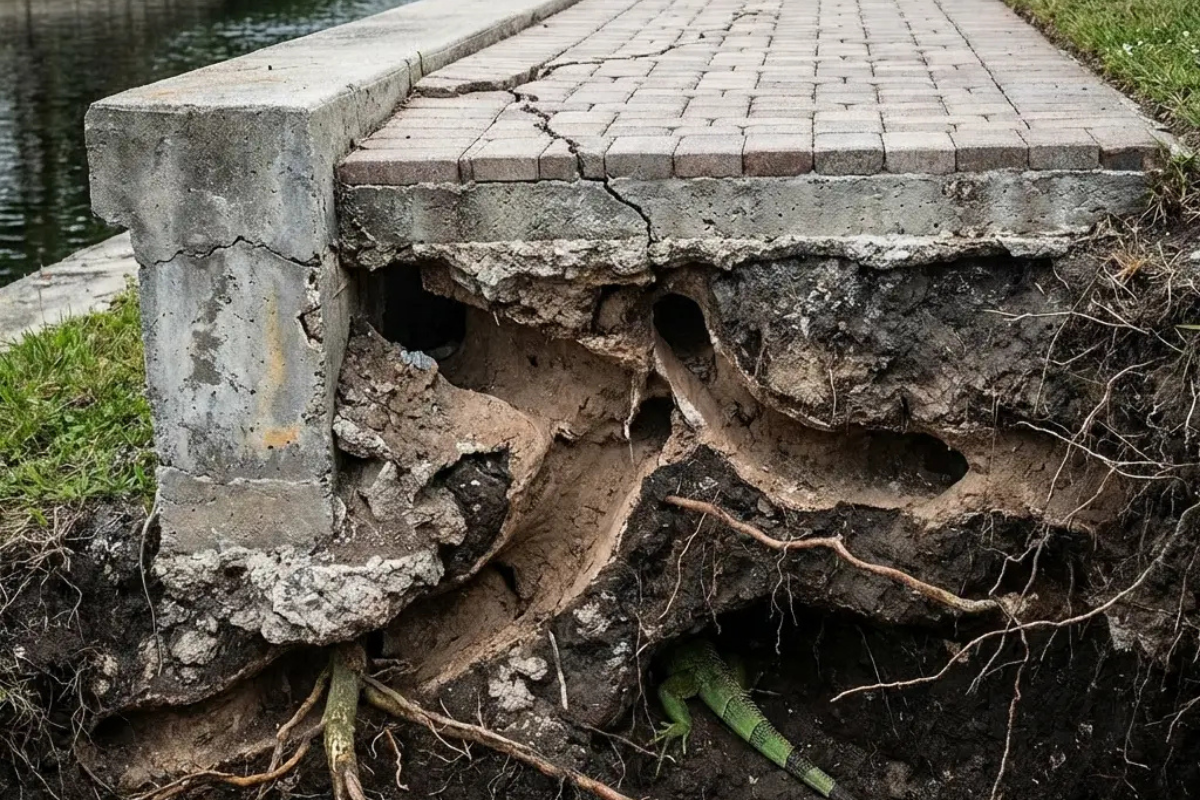
Green iguanas dig burrows. Those burrows erode sidewalks, undermine foundations, collapse seawalls, and destabilize canal banks. In West Palm Beach, iguanas contributed to $1.8 million in damage to a dam controlling water flow into the city’s reservoirs in 2019. The economic toll exceeded that of brown treesnakes on Guam, which cost $375,000 per hour in power outages 30 years ago.
Invasive species cost the United States $1.22 trillion between 1960 and 2020. That’s an average of $19.94 billion annually, but the trend is accelerating. Annual costs jumped from $2.00 billion in the 1960s to $21.08 billion between 2010 and 2020. Most costs—73%—stem from resource damages and losses rather than management expenditures. The industry is reacting, not preventing.
What Underground Damage Looks Like Before You See It
The burrowing happens underground. The structural compromise builds invisibly. Then one day, a sidewalk collapses. A seawall fails. A foundation cracks. You don’t see iguana damage until it’s expensive, and by then, repairs cost 10 to 15 times more than preventative measures would have.
Construction and pest control companies recommend infrastructure inspections for iguana-related damage, looking for underground structural compromises before visible damage appears.
Some construction firms are already adapting. In Miami-Dade County, new waterfront developments now incorporate:
Installing wire mesh around canal walls and banks to deter digging
Constructing sloped and buried fences to prevent iguana entry
Filling iguana burrows with concrete
The Federal Government Is Already Moving
A 2023 white paper for the National Invasive Species Council made a recommendation that changes how construction professionals approach projects: All aspects of U.S. infrastructure—both “gray” infrastructure like levees and bridges, and “green” nature-based solutions like forests and estuaries—should be made more resilient to climate change by actively incorporating the prevention and management of invasive species. Federal agencies are being urged to integrate invasive species considerations into infrastructure resilience planning. Design for this reality now or wait for mandates.
Early Adopters Are Already Building Different
In South Florida, forward-thinking property managers are incorporating invasive-species mitigation into new construction and renovations. Waterfront developments now use subsurface barriers combining stainless steel mesh with concrete footings extending 3-4 feet below grade to address iguana burrowing patterns. While comprehensive data on effectiveness is still emerging, early adopters report that preventative measures—though adding 10-15% to initial foundation costs—eliminate the recurring $20,000-50,000 annual repair bills that neighboring properties without protections continue to face.
Carbon fiber reinforced plastics (CFRP) are 5 times stronger and twice as stiff as traditional materials. Schools in Japan use CFRP wraps to increase shear capacity by 60% while making structures earthquake-resistant.
Self-healing concrete contains special bacteria or chemical agents that activate when exposed to moisture. The material automatically fills cracks and prevents further damage.
The self-healing properties reduce maintenance costs by 15-40% and extend structure lifespans in vulnerable areas by up to 30 years, according to pilot projects in coastal Florida and Texas.
Hybrid sandwich panels used in housing projects in Rotterdam resulted in a 35% reduction in construction time and 28% improvement in thermal performance.
Phase Change Materials (PCMs) absorb, store, and release thermal energy, helping regulate indoor temperatures naturally and reducing energy consumption by up to 30%.
Construction materials account for nearly one-third of global carbon dioxide emissions. Environmental engineers call materials innovation “the last major frontier” in fighting climate change.
The Intersection of Climate, Invasives, and Infrastructure
Fire-tolerant invasive grasses are supercharging wildfires across the United States. In Hawaii, declining rainfall combined with high fuel loads from invasive grasses amplified fire risk, culminating in the 2023 Lahaina fire that demonstrated the lethal intersection of climate change, invasive species, and infrastructure vulnerability. Fire-resistant building materials—metal roofing, fiber-cement siding, composite decking—are becoming standard in vulnerable regions.
The pattern is clear. Climate change creates conditions that favor invasive species. Invasive species create new threats to infrastructure. Infrastructure must adapt to both.
Designing for one without considering the others is futile.
What “Invasive-Resistant” Actually Means
“Invasive-resistant” will become standard construction terminology by 2030.
Economics demand it.
When a single species can cause $1.8 million in damage to one piece of infrastructure, preventative design becomes cheaper than reactive repair.
Regulations are shifting.
Federal agencies are already being urged to integrate invasive species considerations into infrastructure resilience planning. State and local regulations will follow.
The technology exists.
We have materials that can resist burrowing damage, withstand increased moisture from invasive vegetation, and adapt to changing environmental conditions.
Insurance will force it.
As invasive species damage increases, insurers will require invasive-resistant design standards just as they now require flood-resistant and fire-resistant standards in vulnerable areas.
Design Principles for Invasive-Resistant Infrastructure
Barrier integration from the foundation up.
Wire mesh, buried fencing, and physical barriers must be designed into the structure, not added later. Architects and engineers must understand the burrowing patterns, root systems, and access points of invasive species in their region.
Material selection based on biological threats.
Wood is vulnerable to invasive termites. Concrete to invasive plant roots. Materials must be evaluated against specific biological threats, not just weather and wear.
Drainage and water management that account for invasive vegetation.
Invasive plants have different water uptake patterns than native species. This changes how water moves through soil and affects foundation stability. Drainage systems must account for these altered hydrological patterns.
Maintenance access is designed for biological inspection.
Infrastructure must be designed for regular biological threat inspection, not just structural integrity. Access points, inspection ports, and monitoring systems allow early detection of invasive species damage.
Adaptive design that can respond to emerging threats.
The next invasive species is unknown. Design must accommodate future modifications and adaptations without complete reconstruction.
The Business Case You Can Make Today
Reduced long-term maintenance costs. Preventative design costs less than reactive repair. The $1.8 million dam repair in West Palm Beach could have been prevented with proper barrier systems costing approximately $180,000—a 10:1 return on investment. Over a 30-year building lifespan, invasive-resistant design typically saves 8-15% of total maintenance budgets in affected regions.
Increased property value. Properties in fire-prone California areas with fire-resistant construction sell for 6-12% premiums over comparable properties. Early data from South Florida suggests similar premiums emerging for iguana-resistant infrastructure, with commercial properties advertising “invasive-species mitigation” in listings for the first time in 2024.
Insurance advantages. Three major property insurers in Florida now offer 5-10% premium reductions for commercial properties with documented invasive-species mitigation features. As damage claims increase, these discounts will expand to residential properties and other states by 2027.
Regulatory compliance. Getting ahead of coming regulations positions you as an industry leader and avoids costly retrofits when standards change.
Competitive differentiation. Expertise in an emerging specialty that will become standard practice.
The Real Shift Happening Now
Miami-Dade County is drafting building code amendments requiring invasive-species impact assessments for new construction near water bodies. The amendments are expected to pass in 2026, making it the first major U.S. jurisdiction with such requirements. California, Texas, and Hawaii are watching closely.
The Associated General Contractors of America launched a task force in 2024 to develop invasive-resistant construction standards. Their preliminary framework will be published in 2025, with full certification programs rolling out in 2026-2027.
BASF and Sika AG both announced invasive-resistant concrete products in 2024, with marketing campaigns launching in 2025. When the major manufacturers commit resources to a product category, specification becomes mainstream within 36 months.
These aren’t predictions. Their trajectories are already in motion.
What This Means for Your Next Project
Every infrastructure project you design now will face biological threats that didn’t exist—or weren’t significant—when your standard practices were established. Iguana populations in Florida have increased 800% since 2000. Emerald ash borers have killed 99% of ash trees in infested areas. Burmese pythons, zebra mussels, Asian carp—the list expands annually.
The question isn’t whether to adapt. It’s whether you’ll adapt proactively while it’s a competitive advantage, or reactively when it’s a regulatory requirement, and your competitors have a five-year head start.
Miami-Dade’s building code amendments will pass. Other jurisdictions will follow. The insurance industry will price risk accordingly. Material manufacturers will create new product lines.
Your choice is timing, not outcome.
The construction industry that emerges in 2030 will design for biological threats as rigorously as it designs for earthquakes, hurricanes, and floods today. The professionals who thrive will be those who recognized the shift while others were still debating whether it would happen.
The iguanas have already decided. So has the market.