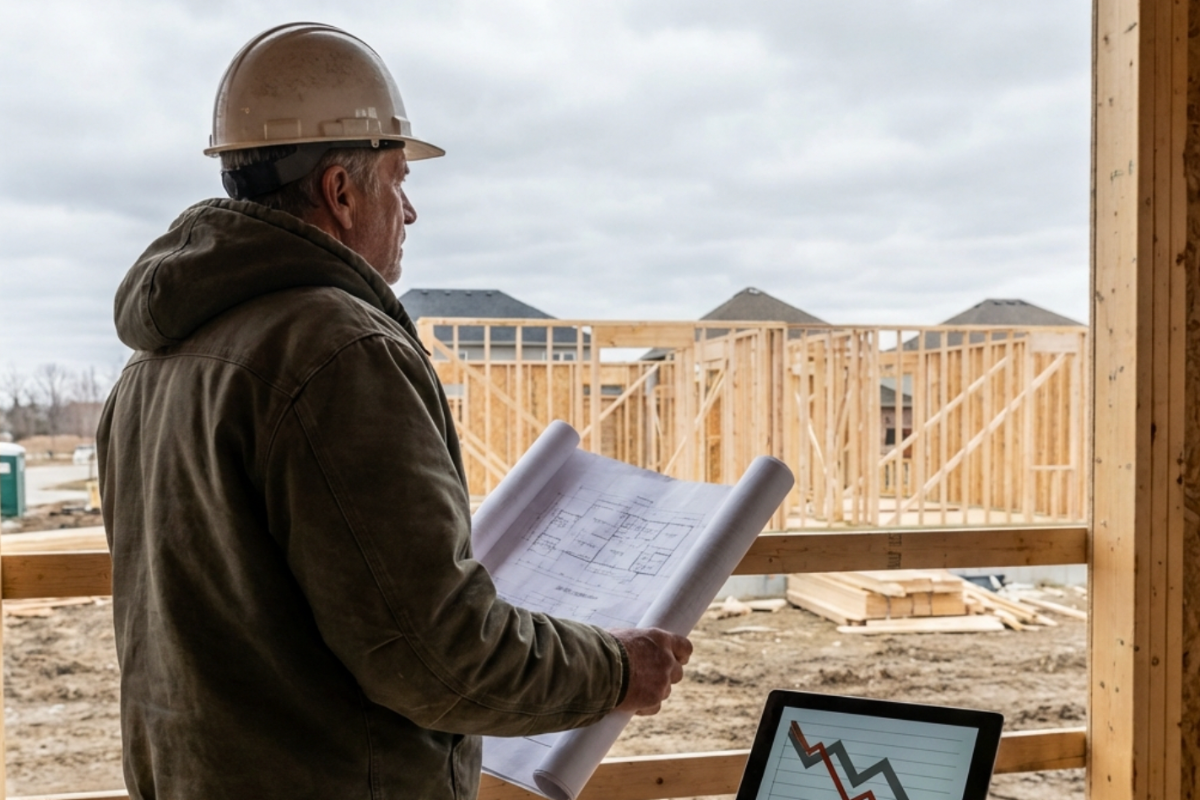
Statewide median sales prices jumped 7.9% to $315,000 in January. Hot market, right?
Not exactly. Existing home sales dropped 3.9% year-over-year. Active listings stayed below 5,000. New listings fell 11.3%—ending a 28-month streak of inventory growth that had given buyers hope.
So which story is real? The rising prices or the cooling activity?
Both. Understanding why matters if you’re building, planning, or investing in Wisconsin construction.
The Supply Crunch Isn’t Getting Better
Wisconsin’s months of available inventory sit at 2.9 months as of January 2026. A balanced market needs six months of supply.
Fewer homes are selling, but prices continue to climb because the homes that do hit the market attract multiple interested buyers. It’s a seller’s market by definition, but one that’s starting to fracture.
The inventory decline reversed nearly two and a half years of steady growth. Total listings dropped 1.7% year-over-year in January.
Translation: Homeowners aren’t listing. And when supply tightens this quickly, prices respond faster than sales volume.
County-Level Data Shows the Real Fractures
Statewide numbers hide what’s happening on the ground. County data reveals the local nature of this market.
Marion County: Median listing price at $299,000—down about 1.5% from January 2025. Homes sat for a median of 93 days. Not a hot market. A market trying to find its footing.
Sheboygan County: Median held at $325,000, down 12.4% year-over-year. Median time on market? 65 days. Faster than Marion, but the price drop signals softer demand.
For construction professionals? Your market isn’t Wisconsin’s market. Your market is the county, the city, sometimes the neighborhood. Statewide trends give you context. Local data gives you direction.
Mortgage Rates Are Doing the Real Work
Wisconsin’s 30-year fixed mortgage rate improved from 6.96% in January 2025 to 6.10% in January 2026. Nationally, rates hit 6.01% as of mid-February—the lowest level since September 2022.
The Wisconsin Housing Affordability Index increased nearly 16% since June 2025. That’s real relief for buyers, even with elevated home prices.
But rates near 6% still constrain affordability compared to the sub-3% environment we saw during the pandemic. Refinance activity has more than doubled over the past year as recent buyers lock in lower payments. That helps individual homeowners but does nothing to add inventory.
The tension: Lower rates should spur buying activity. But if inventory keeps shrinking, buyers have nothing to buy. Demand without supply just pushes prices higher.
The Baby Boomer Release Valve Everyone’s Waiting For
Lower rates help, but they don’t create inventory. That’s where the boomer wave comes in—at least in theory.
Baby boomers now account for 42% of home buyers and 53% of home sellers nationally, according to a 2025 NAR survey. As the youngest boomers turn 62, economists expect significant inventory relief over the next five years as this demographic releases housing stock to younger generations.
But “over the next five years” isn’t helping builders today. And those homes won’t hit the market in Wisconsin at the same pace as Sun Belt states, where boomers have been migrating.
The structural shortage remains real. The U.S. faces a housing deficit of approximately 1.2 million units,s according to NAHB’s 2024 analysis. Homeowner vacancy rates sit at 0.8%—the lowest level on record.
Bottom line: The shortage is improving slowly, but we’re still years away from balance. Wisconsin builders can’t wait for boomers to solve the supply problem.
Construction Costs and Labor Keep Squeezing Margins
Custom home construction costs in Wisconsin range from $220 to $350 per square foot for typical designs. Higher-end homes reach $350 to $500+ per square foot.
Material prices have stabilized above pre-2020 levels, but they’re still growing. Residential building material prices have grown above 3% since June 2025. Tariffs added upward cost pressure in 2026.
Labor remains the bigger constraint. The construction industry reported nearly 300,000 job openings in December 2025. Skilled trade labor shortages drive costs up and timelines out.
Builders want to add supply. The market needs supply. But the math doesn’t always work when labor is scarce, and materials keep creeping higher. Wisconsin single-family new home permits increased only 3.9% for the full year 2025, despite clear demand signals.
Mixed Signals Point to a Slower National Picture
National housing inventory is on track to return to pre-pandemic 2019 levels by mid-2026, currently sitting about 6% below that benchmark after 24 consecutive months of year-over-year inventory growth.
But 2019 was already an undersupplied market. Returning to 2019 levels means returning to a structural deficit that will persist for years.
Regional variations matter more than ever. Migration patterns are bolstering some Southern markets while leaving Midwest markets like Wisconsin with slower growth. The U.S. median list price sits at $399,900. Florida’s median is $425,000. Wisconsin’s $315,000 looks affordable by comparison, but only if inventory exists.
Slower nationwide growth doesn’t mean uniform cooling. Some markets are overheating. Some are stalling. Wisconsin is doing both, depending on where you look.
What This Means for Construction Professionals
You’re navigating a market that defies simple narratives. Prices rise while sales fall. Inventory grew for 28 months, then reversed in one month. Mortgage rates improved, but affordability remains strained.
Track this:
Watch county-level data, not state averages. Marion and Sheboygan counties moved in opposite directions from the state trend. Your pipeline depends on local dynamics.
Plan for continued labor constraints. 300,000 open construction jobs nationally means wage pressure isn’t easing. Factor that into bids and timelines.
Don’t assume boomer inventory will flood your market. It’s coming, but timing and volume vary by region. Wisconsin may see less relief than Sun Belt states.
Material costs are stabilizing, not falling. Budget for 3%+ annual growth. Tariffs add unpredictability.
Mortgage rate improvements help, but 6% isn’t 3%. Buyer demand remains rate-sensitive. A return to 7%+ rates would chill activity fast.
Why the Contradictions Matter
So are rising Wisconsin housing prices real or a mirage?
They’re real—prices are rising because supply is constrained. But the fundamentals supporting those prices are weakening. Buyer demand is cooling. Inventory growth stalled. Sales volume dropped.
A market where price signals and activity signals point in different directions. For builders, that creates both opportunity and risk. Opportunity because the housing supply remains structurally short. Risk because the market could correct quickly if rates spike or inventory floods in.
The mixed signals aren’t going away. Wisconsin’s housing market will remain fragmented by county, by price point, by buyer demographic. Statewide trends will mask local realities.
Your advantage: You’re closer to the ground than economists writing state reports. You know which neighborhoods are moving and which are stalling. You know which buyers are pulling permits and which are waiting.
Use that local knowledge. The data confirms what you already suspected: this market doesn’t move as one. It moves in pieces, and the pieces don’t fit together cleanly.
We’ll keep tracking the data. But the real story is the one you’re living every day on job sites and in bidding rooms across Wisconsin.