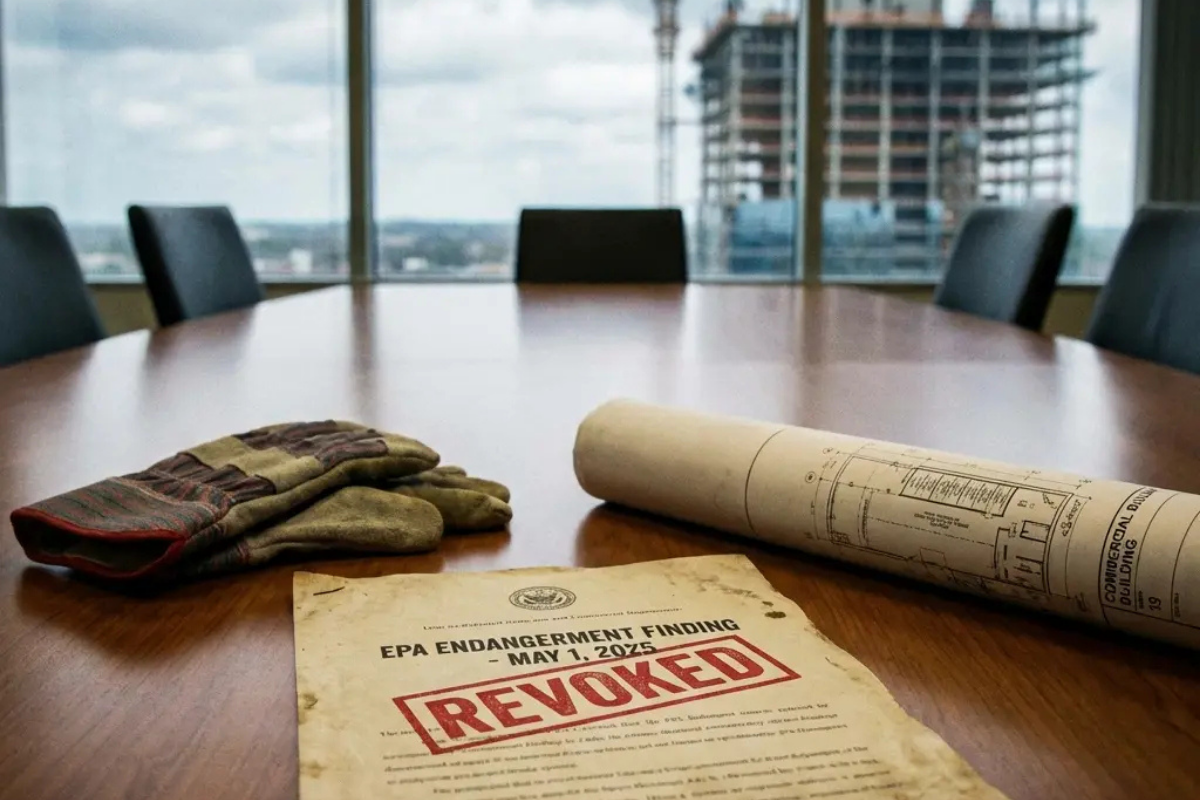
On February 13, 2026, the Trump administration eliminated the legal foundation for every federal greenhouse gas regulation in the United States.
The endangerment finding—the EPA’s 2009 determination that greenhouse gases endanger public health and welfare—served as the legal basis for regulating emissions from vehicle tailpipes, power plants, industrial facilities, and building systems. For construction professionals, this isn’t abstract climate policy. It’s the regulatory framework that governed equipment specifications, building codes, and material standards for 16 years.
EPA Administrator Lee Zeldin stood beside President Trump and declared the finding had “no basis in fact” and “no basis in law.” The Supreme Court and 18 years of federal court rulings say otherwise.
The Legal Foundation Still Stands
The Supreme Court’s 2007 Massachusetts v. EPA ruling established that greenhouse gases are air pollutants under the Clean Air Act. The Court directed the EPA to determine whether these gases endanger public health.
The EPA compiled scientific evidence and adopted the endangerment finding in 2009.
Multiple federal courts have upheld it since then. The U.S. Court of Appeals for the D.C. Circuit rejected legal challenges as recently as 2023. The EPA’s original scientific evidence remains available on the agency’s website today.
Legal precedent and political reality don’t always align. The revocation triggers immediate uncertainty for construction companies navigating building codes, equipment purchases, and projects with 30-50 year lifespans.
Why Construction Professionals Must Pay Attention
The construction industry sits at the center of this policy shift, accounting for 37-40% of global greenhouse gas emissions when combining operational energy use with embodied carbon from materials like steel, cement, and glass.
The endangerment finding provided legal authority for regulations affecting:
Vehicle fleets and heavy equipment
Material transportation logistics
Building heating and cooling systems
Power plant emissions are affecting grid electricity
Manufacturing facilities producing construction materials
Transportation accounts for 75% of direct greenhouse gas emissions in the U.S. For construction companies, this means the legal foundation just vanished for vehicle fleet emission standards, diesel equipment regulations, and refrigerant restrictions on HVAC systems.
Building operations contribute 85% of a building’s total carbon emissions over its lifecycle—the construction phase accounts for just 12.6%. The regulations governing those operational systems just lost their legal foundation.
The Energy Claims Don’t Match Reality
President Trump stated the U.S. has “basically stopped all windmills,” and that wind is the most expensive energy source.
The Energy Information Administration data contradicts this:
New onshore wind: approximately $30 per megawatt-hour
New natural gas: around $65 per megawatt-hour
Advanced nuclear: over $80 per megawatt-hour
Offshore wind: closer to $88 per megawatt-hour
Onshore wind ranks among the cheapest energy sources available—less than half the cost of natural gas generation.
What Happens to Building Codes and Green Standards
In December 2025, the Department of Energy removed support for the National Definition of a Zero Emissions Building.
The DOE withdrew its guidance document and stated that net-zero policies “raise energy costs for American families and businesses, threaten the reliability of our energy system, and undermine our energy and national security.” The Department discouraged state and local governments from referencing or using the definition.
Only 26% of countries worldwide have mandatory building energy codes for the entire sector. The U.S. has historically led in establishing these standards through EPA authority.
The revocation creates uncertainty for green building projects and LEED certifications.
The impact on your projects depends on the jurisdiction.
California, New York, and Washington maintain independent energy efficiency standards exceeding federal minimums. Projects in these states face minimal immediate impact.
States that adopted federal standards as their baseline now operate in a gray zone. Local governments may maintain requirements, strengthen them, or eliminate them. Check with your state energy office for current requirements.
The Court Challenges Are Coming
Federal courts have uniformly rejected legal challenges to the endangerment finding for 16 years.
The Supreme Court established in 2007 that the EPA has the authority to regulate greenhouse gases under the Clean Air Act. The 2009 endangerment finding followed directly from that ruling.
Environmental groups and state attorneys general will file lawsuits challenging the revocation. These cases will argue that the administration cannot discard a finding upheld repeatedly by federal courts without new scientific evidence showing the original determination was wrong.
The EPA’s own scientific evidence remains on the agency’s website. The data supporting the endangerment finding hasn’t changed.
The legal battle will take years to resolve. During that time, construction companies operate in regulatory limbo.
How to Navigate the Uncertainty
Construction companies need strategies that account for multiple possible outcomes.
1. Know your jurisdiction. Determine whether your state has independent building energy codes or relies on federal standards. Contact your state energy office or building department for current requirements.
2. Plan for long timelines. Buildings designed today will operate for 30-50 years. Federal regulations may return before those buildings reach end-of-life. Energy-efficient systems often pay for themselves through operational savings regardless of regulatory requirements.
3. Align with client expectations. Many private developers and institutional clients maintain sustainability commitments independent of government mandates. Corporate net-zero pledges don’t vanish when federal policy changes.
4. Monitor international standards. Projects with international partners or clients may require compliance with standards exceeding current U.S. requirements. The regulatory floor dropped domestically, but global expectations continue rising.
5. Track litigation. Court outcomes will determine whether the revocation stands. Subscribe to construction industry legal updates and monitor EPA announcements for developments.
The Market Reality
The revocation represents a fundamental disagreement about whether federal policy should address construction sector emissions.
The question isn’t whether those emissions exist. The question is whether federal policy will address them.
Physics doesn’t respond to policy. Buildings still consume energy. Materials still require carbon-intensive manufacturing. Transportation still produces emissions.
The market forces driving energy efficiency persist: renewable energy costs continue declining, building owners want lower utility bills, tenants value sustainable spaces, and insurance companies increasingly price climate risk into premiums.
The federal government’s role in setting minimum standards changed. The economic incentives for efficiency did not.
The Regulatory Landscape Ahead
The revocation creates a patchwork regulatory environment.
States will diverge. States with established energy codes will maintain them. States without independent standards face regulatory gaps. Multi-state projects will navigate conflicting requirements.
Professional organizations—the American Institute of Architects, Associated General Contractors, U.S. Green Building Council—will assume larger roles in establishing industry standards without federal mandates.
International standards will gain influence. As U.S. federal requirements weaken and global standards strengthen, companies working internationally will maintain higher specifications to remain competitive.
Litigation will determine the revocation’s fate. Federal courts have consistently upheld the endangerment finding. Judges may conclude the administration cannot revoke it without new scientific evidence contradicting the original determination.
Legal resolution will take years. Construction companies must plan during that uncertainty.
What This Means for Your Business
The administration revoked the legal foundation for federal greenhouse gas regulations despite Supreme Court precedent and contradictory energy cost data.
States with independent standards will maintain course. States relying on federal baselines enter a regulatory gray zone. Court challenges will take years to resolve.
You’re designing buildings with 50-year lifespans in a regulatory environment that may reverse within five years.
Know your jurisdiction. Plan for the long term. Align with clients. Monitor international standards. Track the litigation.
The endangerment finding may be revoked, but building performance physics remains unchanged. Energy efficiency reduces operating costs. Sustainable design adds value. Market forces operate independently of federal policy.
The regulatory landscape shifted. The fundamentals of good building design didn’t.