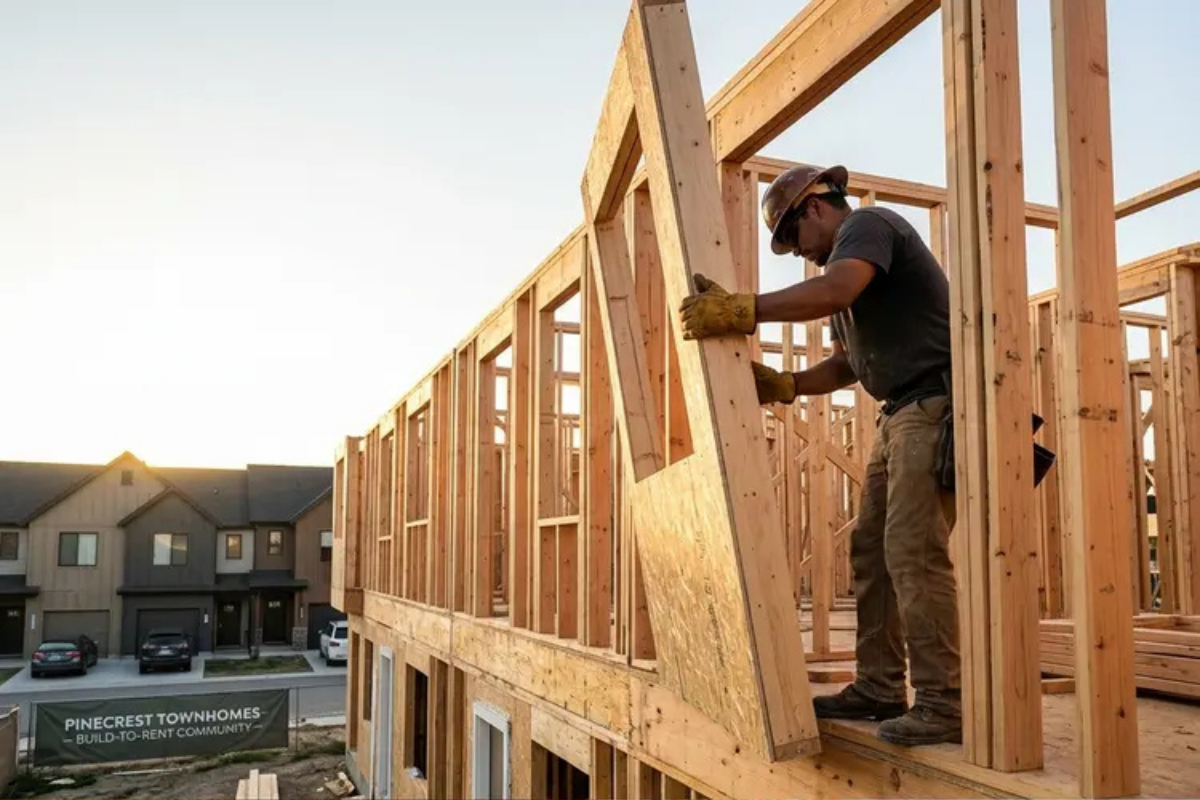
Rental units in multifamily construction starts hit 95% in Q4 2025: 91,000 units built for rent, an 18% jump year-over-year. Townhomes now capture 53% of build-to-rent preferences among industry experts.
When Pinegrove Townhomes opened in Guyton, Virginia, offering 3-bedroom, 2.5-bath units at $1,900 per month, it wasn’t just another rental property. It was a signal of how residential construction economics are being rewritten.
The numbers reveal why developers, architects, and construction professionals need to rethink their approach to the next decade of building.
Why 2025-2026 Is the Inflection Point
Three forces converged to make build-to-rent townhomes the construction opportunity of this decade.
First, mortgage rates. The 30-year fixed mortgage rate averaged 6.8% in early 2026, keeping homeownership expensive. This locks millions of potential buyers into renting longer, creating sustained demand for quality rental housing.
Second, institutional capital. Private equity and REITs poured $74 billion into single-family rentals in 2024 to 2025. Wall Street discovered that single-family rentals, particularly townhomes, offer stable cash flow with lower volatility than traditional apartments.
Third, the demographic wave. Townhomes now represent 53% of build-to-rent preferences among industry experts. Millennials make up 64% of demand: the largest generation in U.S. history, hitting peak household formation years.
Construction costs run lower than those of detached single-family homes while offering the privacy renters want. Efficiency without sacrificing the lifestyle appeal that keeps occupancy rates high.
About 18% of single-family construction now consists of townhomes. A decade ago, that figure sat below 10%.
The Numbers That Make Developers Pay Attention
Build-to-rent townhomes deliver cap rates between 5.5% and 7.2%, with stabilized properties in strong markets hitting the higher end. Compare that to traditional multifamily apartments at 4.8% to 6.5%.
Construction costs per unit run $180,000 to $220,000 for townhomes versus $250,000 to $350,000 for mid-rise apartments. Lower construction costs. Higher returns. Faster lease-up.
Rental townhouses start generating cash faster than traditional apartments. Property management companies can lease a row of five units as soon as that row receives its certificate of occupancy. Compare that to waiting for a 100-unit apartment building to reach completion.
This changes the risk profile entirely.
You’re not sitting on a massive capital investment with zero revenue for 18 to 24 months. You’re phasing in cash flow as construction progresses. Reducing exposure. Creating flexibility in a market that punishes inflexibility.
The build-to-rent model has grown 134% since 2019. That’s not gradual adoption. That’s a fundamental restructuring of how residential construction gets financed and delivered.
The Renter Economics That Make This Work
People ask: “Who rents a townhome when they could buy?”
Renting a build-to-rent home costs roughly $440 per month less than owning an equivalent home. That’s a car payment. That’s childcare. That’s money that stays in someone’s pocket every single month.
Rising home prices have pushed ownership out of reach for many buyers. The “forever renter” trend isn’t a cultural shift. It’s an economic reality.
Millennials make up 64% of build-to-rent demand. They want the single-family home lifestyle without the down payment, maintenance costs, or long-term commitment in a market where job mobility matters.
This creates sustained demand for exactly what developers are building.
Properties like Pinegrove Townhomes at $1,900 per month hit a price point that works for renters while generating returns that work for developers. That’s the sweet spot driving construction activity.
The Supply-Demand Mismatch Fueling Growth
The U.S. housing shortage is estimated at between 2.5 and 5.5 million units. That’s years of underbuilding relative to population growth.
In 2024, just under 1.5 million new homes were authorized. Slightly above pre-2008 averages but far below what the market needs.
The shortage creates an opportunity for construction professionals who understand the economics.
Construction timelines have lengthened post-pandemic. In 2024, 13% of single-family home projects took more than 13 months to complete, up from 9% in 2019. Projects taking four months or more to start rose from 6% to 10%.
This reduces the pace at which new homes reach the market, keeping demand pressure high and making efficient construction models more valuable.
Townhome construction outperforms traditional condos with an 11.1% year-over-year increase. Demand keeps climbing for stacked or low-rise structures that offer density without the complexity of high-rise construction.
The Two Americas of Residential Construction
While townhome rentals boom in the mid-market, luxury real estate tells a different story. Properties like the Macomb, Michigan listing (a 4-bedroom, 3.5-bath home on 10 acres with 5,600 square feet at $565,000) represent the other end of the spectrum.
Luxury real estate outperformed traditional real estate in both sales and value appreciation in 2025. The national entry point for luxury homes now starts around $1.3 million, with foreign buyer activity jumping 44% year over year.
The Macomb property sits in the interesting middle—luxury enough for acreage and space, but priced below the new luxury threshold. It’s the ownership dream for buyers who can afford it, while townhome renters at $1,900 per month choose flexibility and lower financial commitment.
The market is bifurcating. High-end buyers want properties like Macomb’s sprawling estate. Mid-market renters want townhomes that offer a lifestyle without ownership burden. Both segments are growing. Both create construction opportunities. The mistake is trying to serve both with the same product.
Where the Model Works Best (And Where It Doesn’t)
Austin demonstrates what happens when you build enough housing. The city’s surge of new construction drove median rents down from $1,546 in December 2021 to $1,296 by January 2026. From 2021 to 2023, builders averaged permits for 957 apartments per 100,000 residents: the highest rate in the nation.
The Sun Belt dominates build-to-rent activity. Phoenix, Dallas, Fort Worth, Charlotte, and Atlanta lead in new townhome rental construction. These markets offer:
Land costs 40% to 60% lower than coastal metros
- Permitting timelines are 3 to 8 months faster than those in
Northeast cities
Population growth rates 2x to 3x the national average
Pro development zoning that accelerates project timelines
Secondary markets like Raleigh, Nashville, and Tampa show similar patterns. Strong job growth. Reasonable construction costs. Rental demand outpacing supply.
Where the model struggles: High-cost coastal markets with expensive land and lengthy permitting. San Francisco, Los Angeles, and Boston see minimal build-to-rent townhome activity because the economics don’t work at $400,000 or more per unit construction costs.
What Construction Professionals Should Do Now
The opportunity is clear. The question is execution.
For general contractors and builders:
Develop relationships with institutional investors and REITs active in build-to-rent. They’re deploying capital and need construction partners who understand the model.
Focus on the Sun Belt and secondary markets where economics work. Don’t chase coastal projects that can’t pencil.
- Build expertise in phased construction that allows early lease-up
Speed to cash flow matters more than ever.
For architects and designers:
Design for the 3-bed, 2.5-bath sweet spot. That’s what the market wants.
Optimize for construction efficiency while maintaining the single-family feel renters demand.
Think about property management from day one. Ease of maintenance drives long-term returns.
Target markets with strong job growth, reasonable land costs, and favorable zoning.
Aim for construction costs between $180,000 to $220,000 per unit to hit viable returns.
- Price rental units to compete with ownership costs,
minus $400 to $500 per month. That’s where sustained demand lives.
Target markets with strong job growth, reasonable land costs, and favorable zoning.
Aim for construction costs between $180,000-$220,000 per unit to hit viable returns.
- Price rental units to compete with ownership costs,
minus $400-500 per month. That’s where sustained demand lives.
The build-to-rent townhome boom isn’t coming. It’s here. The fundamentals are sound. The capital is available. The demand is proven.
What happens next depends on who builds what the market demands.