Climate change headlines miss a critical point: the ground beneath your projects is shifting, and the timeline is shorter than your models predict.
The Thwaites Glacier in West Antarctica accounts for 4% of global sea level rise and loses 50 billion tons of ice annually, according to the International Thwaites Glacier Collaboration. When it collapses, oceans will rise 65 centimeters worldwide, with potential for 10 feet because it acts as a cork holding back the Antarctic ice sheet.
230 million people worldwide live on land less than 1 meter above high tide lines.
Do the math on your coastal projects.
The Fracture Pattern You Must Recognize
Crack growth in the center of the Thwaites Eastern Ice Shelf now outpaces ice loss caused by melting at its base.
Progressive fracturing over the past two decades has led to the shelf’s gradual detachment from a stabilizing pinning point. The result: accelerated ice flow and reduced mechanical stability. Internal damage and mechanical stress now drive instability more than traditional ocean warming.
The failure mechanism mirrors infrastructure collapse: external environmental stress combines with internal structural weakening. Visible damage appears slowly, then accelerates rapidly. When the problem looks urgent, you’re already behind.
The 30-Year Window Your Plans Depend On
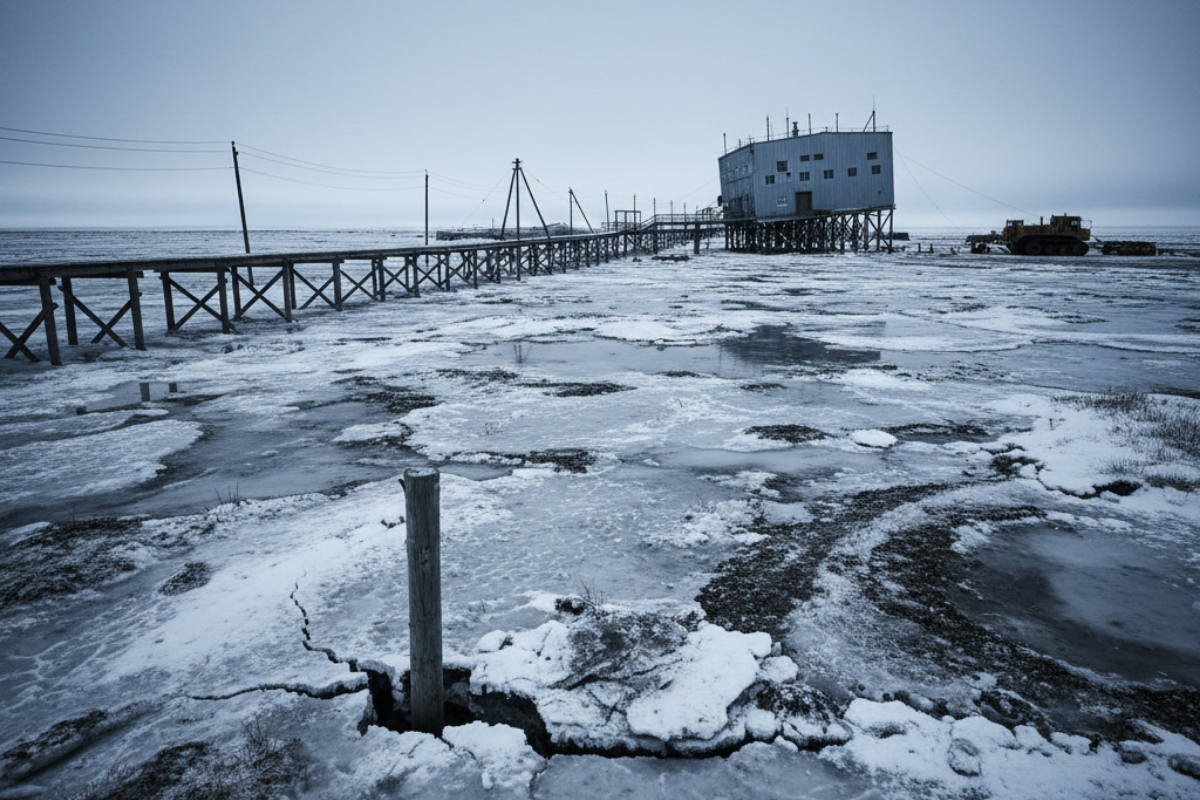
Model simulations suggest that a transition from stable to highly unstable permafrost conditions can occur within the service life of infrastructure construction—approximately 30 years. Current model-based approaches that don’t explicitly account for infrastructure likely underestimate the timing of future Arctic infrastructure failure.
The numbers:
70% of the infrastructure in the Northern Hemisphere’s permafrost region faces vulnerability to near-surface permafrost thaw
$37 billion to $51 billion in potential building and road losses in Alaska alone under medium and high emission scenarios
47% expansion of building footprint mapping statewide and 86% on discontinuous and continuous permafrost zones
Alaska’s building footprint: 53 million square meters. Road network: 50,477 km. Actual infrastructure exposure exceeds previous estimates significantly.
You’re not just planning for the weather. You’re planning for ground conditions that will fundamentally change within your project’s operational lifetime.
What River Ice Tells Us About System Failure
Alaskan rivers now maintain persistent open-water zones through winter. Increased early-winter river flows and ice jams prevent complete freezing.
This creates safety hazards for winter travel and disrupts traditional ecological patterns. The system doesn’t gradually warm—it breaks in specific, predictable ways that cascade through connected infrastructure.
Your projects sit within similar systems. Power grids. Water treatment. Transportation networks. When one component fails outside its design parameters, the failure propagates.
Construction implications: Bridges require ice-resistant pier designs and real-time monitoring systems. Water intake structures need repositioning for changing ice conditions. Road foundations must account for irregular freeze-thaw cycles that accelerate pavement degradation.
The Investment Case Your Stakeholders Need to Hear
Climate-resilient infrastructure delivers a 7:1 return on investment. Nature-based solutions like wetland and reef restoration in the Gulf of Mexico yield benefit-to-cost ratios greater than seven to one—seven dollars in flood-reduction benefits for every dollar spent on restoration.
The data:
Coastal wetlands in the U.S. provide $23.2 billion in storm protection services every year
MIT research found investments in climate-resilient construction pay for themselves within two years in avoided damage costs
By adopting updated building code changes, homeowners save $11 per dollar invested
As of November 2020, only 35% of U.S. counties, cities, and towns had adopted the latest building codes, making millions vulnerable to higher energy costs and extreme weather. This gap continues to widen as climate impacts accelerate faster than code adoption.
The Code Changes Coming to Your Projects
The 2027 International Codes (I-Codes) will include a new chapter covering weather-related threats being exacerbated by climate change. This includes flooding, ic,e and wind.
The 2024 I-Codes already include provisions for tornado loadings and revised standards for wind, earthquake, snow, and rain loads adjusted based on the latest climate data and weather hazards. The American Society of Civil Engineers’ ASCE 7 latest edition features a new supplement addressing how climate change leads to increased flooding and sea-level rise.
Your current projects need to anticipate these standards. Retrofitting costs more than building right the first time.
Construction Techniques That Address These Risks
For permafrost regions:
Thermosyphons and heat pipes that extract ground heat and prevent thaw
Adjustable foundation systems using screw piles or hydraulic jacks that accommodate ground movement
Elevated structures with ventilated air gaps to minimize heat transfer to permafrost
Insulated foundations with vapor barriers to control thermal bridging
For coastal zones:
Amphibious foundations that allow structures to float during flooding
Elevated first floors with breakaway walls in flood zones
Hybrid gray-green infrastructure combining seawalls with wetland buffers
Marine-grade concrete with corrosion inhibitors for saltwater exposure
For all projects:
Modular design allowing component replacement without full demolition
Material selection prioritizing durability under extreme temperature swings
Drainage systems oversized for increased precipitation intensity
What This Means for Your Next Design Review
Ask different questions in your planning meetings:
For coastal projects: What does a 65-centimeter sea level rise mean for this site over its operational lifetime? What about the ultimate 10-foot scenario? Which foundation type—fixed, amphibious, or elevated—matches the risk profile?
For northern infrastructure: How do we account for permafrost instability within 30 years? What’s our transition plan when ground conditions change? Are thermosyphons or adjustable foundations more cost-effective for this site?
For building code compliance: Are we designing to current codes or the anticipated 2027 standards? What’s the cost difference? Can we phase the implementation to spread costs?
For investment justification: How do we quantify the 7:1 ROI on resilient design? What’s the two-year payback calculation for our specific project? Which resilient features provide insurance value versus operational savings?
The Timeline That Matters
Internal fracturing accelerates the collapse faster than external melting alone. Your projects face compound stresses—regulatory changes, material availability, labor costs, and environmental conditions shifting simultaneously.
30-year window on permafrost. 3-year warning on building code changes. 7:1 ROI on resilient design.
Next Steps
Identify which assets face the highest exposure to sea level rise, permafrost thaw, or extreme weather events. Run the numbers on resilient design options using the 7:1 ROI framework.
Review your specifications against the 2024 I-Codes and anticipated 2027 standards. Calculate the cost difference between the current compliance and the future-proofed design.
A 30-year infrastructure lifespan means designing for 2055 conditions. Check your model assumptions.
The ground is shifting. Your timeline is shorter than your models predict. The tools, data, and business case for resilient infrastructure exist.