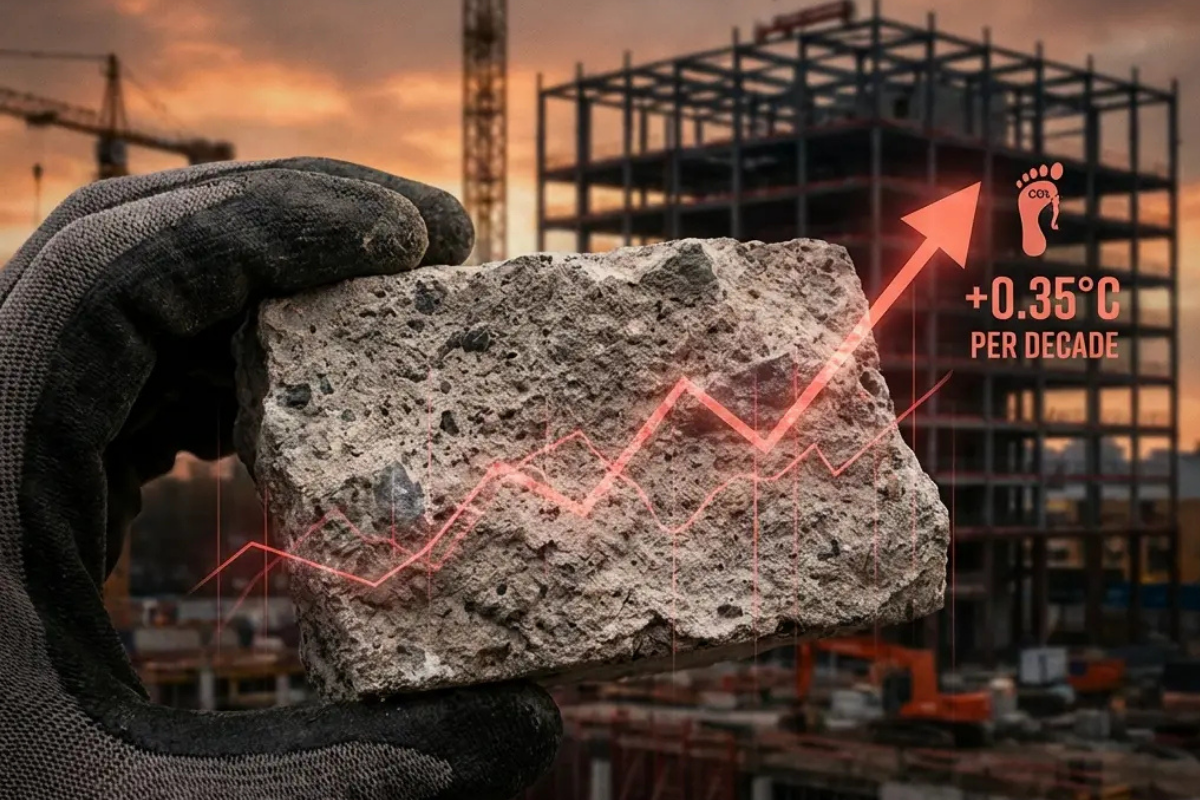
Global warming has accelerated to 0.35°C per decade since 2015, nearly double the 1970-2015 rate of 0.2°C per decade. This is the fastest warming pace since instrumental records began in 1880.
Researchers at the Potsdam Institute removed natural variability, El Niño cycles, volcanic eruptions, and solar fluctuations, and the acceleration holds with 98% statistical certainty. NASA, NOAA, Berkeley Earth, and Copernicus confirm it.
At this rate, we breach the Paris Agreement’s 1.5°C limit by 2030. What changed?
The Aerosol Mask Is Coming Off
Part of the answer lies in something we actually did right.
We cleaned up air pollution. We reduced aerosol emissions, tiny particles from industrial processes, shipping fuel, and combustion that reflect sunlight into space.
These aerosols were masking the true extent of warming. As we reduced them for health reasons, we inadvertently revealed the full force of greenhouse gas accumulation.
The warming was there. We couldn’t see it clearly.
Another contributor doesn’t get enough attention: the construction industry.
Construction’s Explosive Carbon Growth
The global construction sector’s carbon footprint doubled over three decades and will double again by 2050. In 2022, three materials, cement, bricks, and metals, generated over half of construction’s emissions.
Under business-as-usual, construction’s carbon footprint will exceed the entire per-annum budget needed to stay within 1.5°C and 2°C goals. One sector could blow the whole budget.
Buildings and construction account for 37-39% of global energy-related CO₂ emissions the largest single source of greenhouse gases globally. Building operations contribute 28%, while embodied carbon from materials and construction adds 7-11%.
The Upfront Climate Impact Nobody Talks About
Most people think about a building’s energy use over its lifetime, including the heating, cooling, and lighting.
But embodied carbon, the emissions from producing and transporting materials, accounts for 11% of global greenhouse gas emissions.
Most of a building’s lifetime emissions occur before anyone occupies it. Decisions made during design lock in irreversible climate impacts you can’t retrofit embodied carbon later.
Cement, steel, and aluminum production are responsible for 18% of building-related emissions. The 76 million tons of finished concrete produced annually generates 9.8% of global CO₂. In London alone, construction accounts for 30% of particulate matter emissions, 40% of drinking water pollution, and 50% of landfill waste.
The Timing Isn’t Coincidental
The construction boom of the past decade coincides with the acceleration period. As developing nations urbanize and developed nations rebuild infrastructure, construction activity has surged, requiring massive cement, steel, and aluminum production. These are the most carbon-intensive industrial processes on the planet.
While we reduced aerosol pollution from some sources, construction ramped up materials emissions. The net effect: faster warming than climate models predicted, which assumed gradual changes and didn’t account for explosive building activity growth.
The Construction-Warming Correlation
The years 2023-2025 averaged around or above 1.5°C over pre-industrial levels. This isn’t a spike—we’ve entered a new climate regime. When you map construction emissions against the warming acceleration timeline, the correlation is striking:
2015-2020: Global construction activity increased 23%. Warming rate: 0.35°C per decade.
1970-2015: More gradual construction growth. Warming rate: under 0.2°C per decade.
The Potsdam team warns that emission-cutting efforts fail to account for construction’s growing contribution. The relationship isn’t perfectly linear, but the trend is undeniable.
Why These Materials Matter
Cementitious materials, bricks, and metals accounted for 55% of construction emissions in 2022. Cement production is problematic because converting limestone to cement releases CO₂ directly, independent of energy used—unavoidable with traditional methods. Steel requires extreme heat from burning coal. Aluminum demands massive amounts of electricity, often from fossil fuels.
China produces more cement than the rest of the world combined. India’s construction sector grows at double-digit rates. The developing world builds the equivalent of a new Paris every week.
Speed Kills
The Potsdam study emphasizes that the warming rate matters as much as total warming. Ecosystems adapt to gradual change but struggle with rapid shifts. We’re not just building more, we’re building faster, using methods optimized for speed and cost rather than carbon impact.
Fast-track schedules favor conventional materials with known properties and established supply chains, the most carbon-intensive options. Low-carbon alternatives require different planning timelines, supply chains, and construction methods. Industry momentum favors business as usual.
What Low-Carbon Construction Actually Looks Like
The research shows that utilizing low-carbon materials yields remarkable reductions: a 40% decrease in material embodied carbon and a 39% decrease in transportation carbon footprint compared to conventional materials.
You can reduce embodied energy and carbon by 10-20% without adding cost. The Microsoft Silicon Valley Campus achieved 35-36% embodied carbon reduction through mass timber construction. The Kendeda Building in Atlanta used mass timber with minimal steel and concrete, reducing structural embodied carbon significantly.
The techniques include:
Optimizing structural design to use less material overall
Substituting high-carbon materials with lower-carbon alternatives
Sourcing materials locally to reduce transportation emissions
Reusing and recycling materials from demolition projects
Specifying cement blends with supplementary cementitious materials
Using timber in place of steel and concrete where structurally appropriate
These techniques are available now. The barrier isn’t technical capability—it’s industry inertia and procurement practices that don’t account for carbon impact.
The Timeline Problem
We could breach 1.5°C by 2030. Buildings designed today will stand 50-100 years. The carbon we emit building them is locked in. The materials we specify now determine our carbon trajectory for the next century.
If construction emissions continue on their current path, they’ll consume the remaining carbon budget before mid-century. Every conventional building started today makes the climate math harder.
The Policy Gap
Climate policy has focused on operational carbon—the energy buildings use once occupied. Building codes mandate efficient HVAC systems, better insulation, and LED lighting.
These measures help, but ignore embodied carbon. Few jurisdictions regulate the carbon intensity of construction materials or require lifecycle carbon assessments before permits. We’re optimizing the wrong variable—making buildings energy-efficient while ignoring the carbon debt incurred during construction.
What This Means for Construction Professionals
You’re facing a reckoning.
The accelerated warming identified in the Potsdam study means the timeline for climate action has just compressed. The luxury of gradual transition is gone.
Clients will start asking about embodied carbon. Regulators will start measuring it. Insurance companies will start pricing climate risk into projects.
The professionals who adapt now gain a competitive advantage. Those who wait will find themselves explaining why their methods contribute to a problem everyone else is trying to solve.
This isn’t about virtue signaling or green marketing. It’s about the physical reality of what we’re building and the atmosphere we’re building it into.
The Tipping Point Risk
The Potsdam researchers warn of climate tipping points—thresholds beyond which systems shift into new stable states. The Amazon is converting to a savanna. Greenland ice is entering irreversible melt. Ocean currents are reorganizing. We don’t know where these thresholds lie, but faster warming increases the risk of crossing them.
Construction’s contribution to warming acceleration pushes us toward these points. The feedback loops are visible: permafrost thaw releases methane, which accelerates warming, which thaws more permafrost. Once started, they become self-reinforcing.
The Path Forward
The Potsdam study concludes faster moves to net-zero are needed. For construction, this means:
Immediate actions:
Conduct lifecycle carbon assessments on all new projects
Specify low-carbon concrete mixes as the default
Design for material efficiency before aesthetic excess
Source materials from suppliers with decarbonization commitments
Prioritize renovation and adaptive reuse over new construction
Medium-term shifts:
Invest in training for low-carbon construction methods
Build relationships with suppliers of alternative materials
Advocate for embodied carbon regulations and incentives
Develop internal carbon accounting systems
Integrate carbon impact into project evaluation criteria
Long-term transformation:
- Support the
development of zero-carbon cement and steel
Push for circular economy approaches in construction
Demand carbon transparency from the entire supply chain
Collaborate across the industry to share best practices
Recognize that business as usual is no longer viable
The Answer
Are construction methods accelerating climate change more than we think?
Yes. The sector’s carbon footprint doubled in three decades and will double again by 2050, coinciding with the warming acceleration identified in the Potsdam study. The industry accounts for 37-39% of global energy-related emissions. The warming rate has nearly doubled since 2015. Construction activity surged during the same period.
The Bottom Line
We have less than a decade to transform how we build. The construction industry moves slowly, projects take years, supply chains are complex, and standards lag behind science. But physics doesn’t care about institutional constraints. The atmosphere responds to what we emit, not what we intend to emit.
The professionals who recognize this now will shape the industry’s response. The data is clear. The timeline is compressed. The methods that got us here won’t get us where we need to go. The question is whether we’ll change fast enough to matter.