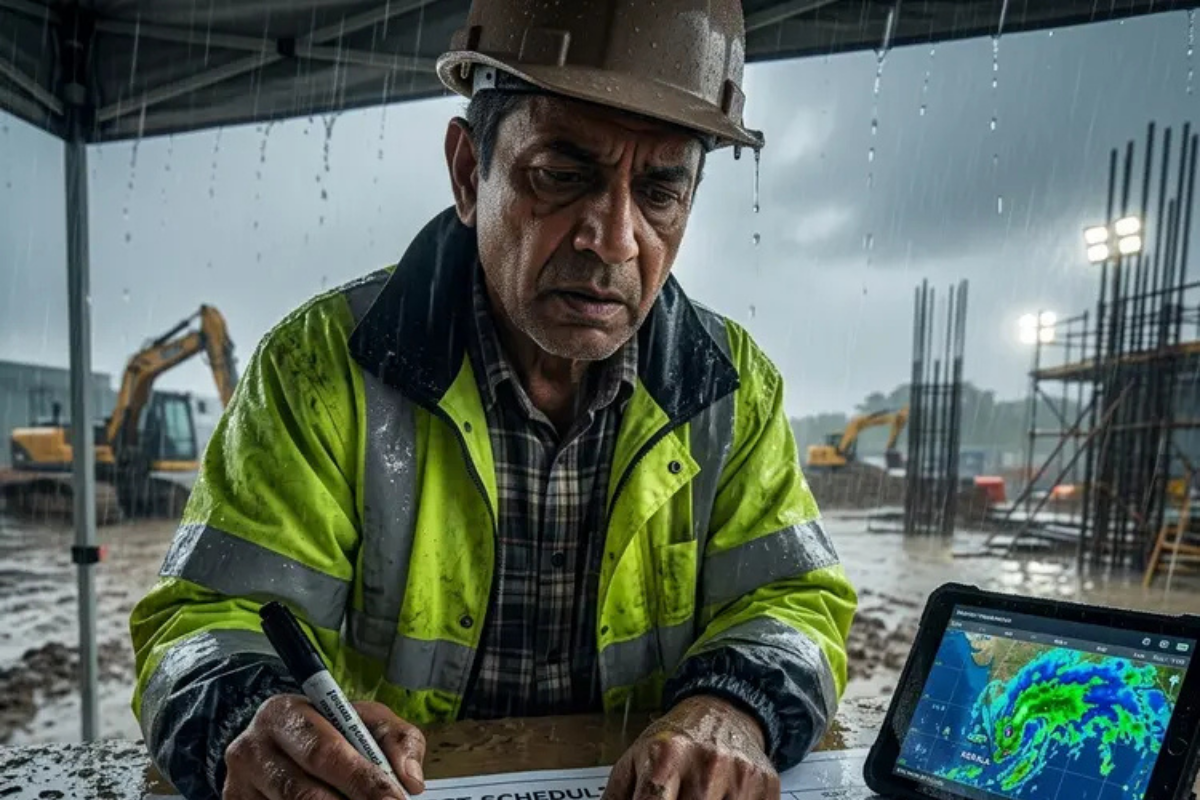
The India Meteorological Department’s April 29 yellow alert for Kerala arrived weeks early. The monsoon didn’t get the memo about traditional calendars.
This is the new baseline.
The southwest monsoon is expected to reach the Andaman and Nicobar Islands between May 18 and 25, then push toward India’s southwest coast around late May. The World Meteorological Organization indicates equatorial Pacific sea-surface temperatures are shifting toward El Niño, with a 61% probability of onset between May and July 2026.
For construction professionals who’ve spent decades calibrating project timelines around predictable monsoon windows: your planning assumptions are obsolete.
The Pattern That Broke the Pattern
El Niño events disrupt regional weather systems. The 2026 forecast suggests one of the strongest events in decades.
India’s 2026 South West Monsoon is likely to be below normal or deficient, according to the India Meteorological Department’s April 13 forecast. This marked the first below-normal monsoon forecast in India’s April prediction since 2015.
The contradiction is sharp. Early rains in Kerala. Below-normal seasonal rainfall predicted. A tropical system with 20-40% formation probability north of the Andamans that could enhance early precipitation.
The monsoon is not simply arriving early. It is arriving differently.
The Madden-Julian Oscillation, a 30- to 60-day atmospheric cycle that propagates eastward through the Indian and Pacific oceans, is amplifying moisture transport into Kerala. Researchers project a nearly 60% increase in extreme rainfall over tropical Asia and Australia by the end of the 21st century, with 84% of this change driven by MJO-induced extreme rainfall.
You cannot schedule around this level of variability using last decade’s calendar.
What Weather Volatility Actually Costs
Adverse weather delays 45% of construction projects worldwide. The financial impact extends beyond schedule slippage.
A single day of lost productivity on a $200 million construction project can cost up to $250,000 in labor, leased equipment, and contractual penalties. With a 10% profit margin yielding just $20 million, that single day significantly impacts the bottom line.
Construction material costs rose about 20% in 2023, with timber increasing by up to 50% in some regions following weather-driven supply shocks. That $250,000 daily loss multiplies when material delays compound schedule slippage. When the monsoon arrives early and unpredictably, material supply chains compress. Delivery windows shrink. Inventory costs spike.
The below-normal seasonal rainfall forecast presents a different risk. Around 60% of Indian farmers depend completely on monsoon rainfall for the Kharif cropping season. Deficient rainfall creates labor availability challenges as agricultural work patterns shift and disrupts cement production, which requires a consistent water supply.
Weather volatility does not just delay projects. It restructures your cost model.
The Compounding Effect
Weather disasters have more than doubled since 1980. In the four decades following 1980, severe weather events occurred an average of 7.9 times per year. In the last five years, that average jumped to 17.8 per year, with losses totaling $595.5 billion.
The trend isn’t plateauing. Climate projections show that a global temperature change of 2.7 °C by century’s end could decrease worker productivity by as much as 52%.
You’re managing a fundamentally altered risk environment.
Why Traditional Monsoon Planning Fails Now
Traditional construction planning in monsoon-affected regions relied on three assumptions:
Predictable onset dates based on historical averages
Consistent intensity patterns throughout the season
Clear dry windows for critical construction phases
All three are breaking down simultaneously.
The early monsoon arrival in Kerala, driven by MJO-enhanced moisture transport, demonstrates the first failure. You can’t plan concrete pours or foundation work around a monsoon calendar that shifts by weeks.
The second failure shows up in intensity. El Niño creates below-normal seasonal totals but concentrates precipitation into shorter, more intense events. Your drainage systems and erosion controls are designed for steady seasonal rain, not compressed downpours.
The third failure is the most damaging. Dry windows are unpredictable. When you can’t reliably schedule exterior work, roofing, or finishing phases, your critical path dissolves.
The issue isn’t that weather is worse. The issue is that weather is unknowable using your current planning tools.
The False Comfort of Contingency Buffers
Allocating 5% to 10% of the project budget for weather contingencies is industry best practice. Flexible contracts have been linked to a 15% reduction in schedule disruptions caused by weather.
Contingency buffers help. They do not solve the underlying problem.
A contingency assumes you know the range of possible disruptions. When the monsoon arrives three weeks early, your contingency covers the first delay. When a tropical system forms and dumps concentrated rainfall during what should be a dry phase, it covers the second delay.
When both happen in the same season, your contingency is exhausted and your schedule is broken.
What Adaptive Planning Actually Looks Like
Construction firms managing weather volatility effectively aren’t adding bigger buffers. They’re fundamentally changing how they plan and execute projects.
Real-Time Weather Integration
You need weather data integrated into your project management system, not as a reference but as a dynamic constraint. When the MJO indicates enhanced moisture transport toward your project site, your scheduling software should automatically flag affected tasks and propose alternative sequencing.
This requires moving beyond weekly weather checks. You need daily updates on El Niño conditions, MJO phase tracking, and regional precipitation forecasts extending 10 to 14 days out.
Modular Sequencing
Traditional construction sequencing assumes linear progression through phases. Adaptive sequencing breaks projects into smaller, independently completable modules that can be reordered based on weather windows.
When heavy rain is forecast for the next 72 hours, you shift from exterior work to interior fit-out, prefabrication, or equipment installation. The project moves forward even when the weather closes one work front.
Material Stockpiling and Just-in-Case Inventory
Just-in-time inventory reduces carrying costs. It creates single points of failure when the weather disrupts supply chains.
Firms in high-volatility weather zones are returning to strategic stockpiling of critical materials. When timber prices spike 50% due to weather-driven supply shocks, having inventory on hand is risk management.
Contract Structures That Share Weather Risk
Traditional fixed-price contracts push all weather risk onto the contractor. When the weather becomes fundamentally unpredictable, this creates an uninsurable risk that gets priced into bids or absorbed as losses.
Progressive design-build contracts, cost-plus structures with weather adjustment clauses, and shared savings models distribute weather risk more equitably. The Construction Industry Institute found that adding weather contingencies to contracts lowers weather-related claim costs by about 10%.
The goal is not to eliminate weather risk. The goal is to make weather risk manageable for all parties.
Case Study: When Early Monsoon Meets Rigid Planning
A major infrastructure contractor in Karnataka scheduled foundation work for late May 2025, banking on historical dry windows. The monsoon arrived 18 days early. With no modular sequencing in place, the crew idled for three weeks while equipment lease costs accumulated. The project absorbed $1.2 million in delays before shifting to adaptive scheduling, a lesson that cost more than implementing flexible planning from the start.
First Steps: What to Do Monday Morning
You don’t need to overhaul your entire operation overnight. Start here:
Audit current projects for weather assumptions. Identify which tasks depend on predictable dry windows. Flag them as high-risk.
Subscribe to extended weather forecasts. Move beyond weekly checks. Get 10- to 14-day precipitation forecasts and MJO phase updates integrated into your planning meetings.
Map modular alternatives for weather-sensitive tasks. For every exterior or weather-dependent phase, identify indoor or covered work that can substitute when conditions shift.
Initiate contract language review. Work with legal to draft weather adjustment clauses for upcoming bids. Don’t wait until you’re underwater on a fixed-price contract.
The Uncomfortable Truth About Climate Adaptation
The construction industry has treated weather as an external variable to be planned around. The early monsoon driven by El Niño and amplified by the Madden-Julian Oscillation reveals a different reality.
Weather is now a core operational parameter that requires the same attention, investment, and strategic planning as labor, materials, and equipment.
You can’t schedule your way out using historical averages. You can’t buffer your way out using larger contingencies. You can’t wait for weather patterns to stabilize.
The monsoon is not coming late. Your planning model is.
Key Takeaways
The 2026 monsoon is arriving weeks early while seasonal totals are forecast below normal, creating compressed, intense rainfall instead of predictable patterns.
Traditional contingency buffers fail when multiple weather disruptions hit the same season, exhausting reserves and breaking schedules.
Adaptive planning requires four shifts: real-time weather integration, modular task sequencing, strategic material stockpiling, and risk-sharing contract structures.
Weather is now a core operational parameter, not an external variable—demanding the same strategic attention as labor and materials.
Construction professionals who recognize this shift and rebuild their planning frameworks around real-time weather data, modular sequencing, and adaptive risk sharing will maintain project momentum. Those who continue optimizing last decade’s monsoon calendar will watch their schedules collapse.
The yellow alert for heavy rain in Kerala isn’t just a weather forecast. It’s a signal that the old playbook has expired.
What you build next starts with acknowledging that fact. This week, audit which of your current projects assume predictable dry windows, then identify which tasks can shift to modular sequencing. The firms that adapt now will keep building. The ones that wait will keep explaining delays.